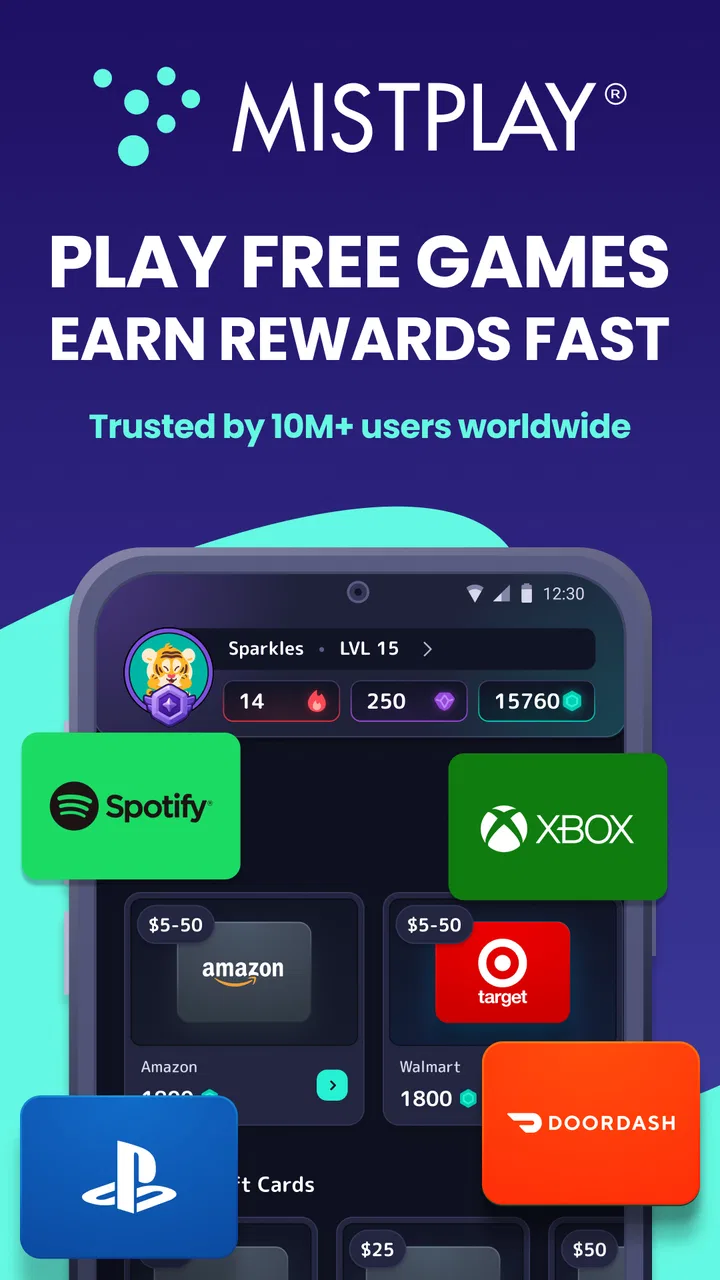
MISTPLAY: Play to Earn Money
- 4.4
- Rating
- 50.00M
- Installs
- Free
- Price

 Analysis by App-foxy
I approached MISTPLAY as something a household might use casually rather than as a serious income tool. It is an entertainment app from MISTPLAY that brings games together and connects play with rewards such as gift cards and cash-out prizes. That sounds simple, but the useful question is whether it fits the way you and the people around you actually use phones, games, and shared expectations about spending time online.
My first impression was that its appeal comes from combining two activities that already make sense together: discovering mobile games and receiving something in return for playing them. The app is free, carries a Teen content rating, and supports devices running Android 7.0 or later. Its current version is 6.12.0, so compatibility is worth checking before anyone in the household plans around it. I would treat the rewards as a small extra rather than a dependable source of money.
How MISTPLAY Works in a Shared Household
When I consider MISTPLAY in a shared household, I focus less on pooling activity and more on keeping one person’s account and choices clear. A practical next step is to agree in advance who selects games and who decides what happens to a reward, so a casual evening doesn’t turn into a dispute over progress. That boundary matters even more when the device is used by a teenager.
You May Also Like

 Blood Strike: 2.5 Anniversary
Blood Strike’s Loadouts Turn Every Drop Into a Tactical Gamble
A close look at Blood Strike’s custom loadouts: how fast access to signature weapons reshapes its battle royale rhythm, rewards preparation, and narrows the gap between fights.

 Pandora - Music & Podcasts
Pandora’s Music Is Easy to Start, but Harder to Recover
Pandora’s strength is its low-effort path from a seed to a station. Its weak spot is how much confidence it asks you to place in connection, setup, and quiet recovery.

 8 Ball Pool
 Is Built on Rivalries, Rematches, and Routine
A close look at the rivalries, rematches, shared routines, and unanswered safety questions that turn a quick pool match into a persistent mobile community.

 Samsung Music
’s Quiet Strength Is Playing What You Already Own
Its reach comes less from spectacle than from dependable access to a personal library. That simplicity is both the app’s strongest retention engine and its ceiling.

 AccuWeather: Weather Radar
AccuWeather Review: A Quick, Clear Forecast for Everyday Decisions
For everyday plans, the best forecast is the one you can understand quickly. AccuWeather makes rain timing, radar, and local conditions easy to act on, with a few trade-offs.

 Hill Climb Racing
Why Hill Climb Racing Still Turns Crashes Into One More Run
A tiny car, a bumpy hill and one more upgrade: Hill Climb Racing keeps resurfacing because its simple chaos makes every near-miss feel personal.
More From Our News Desk
View All News


A practical scenario for one phone, several people
Imagine a family tablet or a spare phone that is used during quiet evenings. One person may want a puzzle game, another may prefer a strategy title, and a teenager may be interested in trying several games without paying for each one. In that situation, MISTPLAY can act as a discovery layer: instead of searching through the wider app marketplace every time, the user starts inside the rewards-focused catalog and chooses something that looks worthwhile.
The important distinction is that this is not the same as handing the device to everyone and assuming the rewards will sort themselves out. A household needs to decide who is using the account, whose device is involved, and who is entitled to any reward earned. I found that this simple conversation matters more than the promotional idea of “playing to earn.” Without it, a shared device can create confusion about progress, redemption, and personal information.
For a single adult using one personal phone, the experience is easier to understand. The app becomes a place to browse games during spare time, then keep track of rewards connected with that activity. For a shared device, however, the account should belong clearly to one person at a time. Switching between people may make the experience feel communal, but it also makes ownership and progress harder to follow.
What the initial setup should clarify
Before installing it for a teenager or placing it on a family tablet, I would establish a few boundaries. Decide whether the app is for one account holder or several people taking turns. Decide whether games downloaded through it are appropriate for the intended user. Also agree that no one should redeem a reward or change account details without the account holder’s permission.
These are not complicated rules, but they prevent the most common household friction. A rewards app can feel harmless because the activity is gaming, yet the account still has value. Treating it like a shared streaming profile is not ideal if one person’s play affects another person’s reward balance or recommendations.
I would also avoid presenting the app as payment for chores or as guaranteed pocket money. The better framing is “an optional way to make recreational gaming more rewarding.” That wording keeps expectations realistic and helps younger users understand that the main activity remains playing games, not earning a predictable wage.
Keeping play and rewards easy to coordinate
Coordination works best when the household chooses a regular moment to check the account rather than interrupting every gaming session to discuss it. For example, an account holder could review available rewards after a few sessions and decide whether to continue with the current games or try something else. This makes the reward side deliberate instead of turning every minute of play into a negotiation.
A useful habit is to keep the app associated with the person who actually uses it. If a parent installs it on a child’s personal device, the family can discuss what the rewards are for and who approves redemptions. If siblings share a tablet, I would be more cautious: either assign the account to one user or accept that the device is better for browsing games than for tracking individual effort.
Another practical tip is to avoid starting several games at once simply because they appear in the catalog. A user can quickly end up with a crowded device, scattered attention, and no clear sense of which games are genuinely enjoyable. I would begin with one or two titles, see whether they hold attention beyond the first session, and only then expand. That approach also makes it easier to understand which activity is connected with the reward progress.
Age, trust, and the limits of supervision
The Teen rating is an important part of the decision. It does not mean every game or every situation will suit every teenager, and it certainly does not remove the need for a parent or guardian to discuss downloads, play time, and redemptions. I would not install it for a younger child without first checking the device, the selected games, and the household’s own rules.
Trust matters because the app combines entertainment with incentives. A young user may focus on the reward and overlook how much time is passing. I would explain that rewards are not a reason to keep playing when the game has stopped being fun, and that no reward is worth ignoring schoolwork, sleep, or agreed screen limits.
On a shared device, privacy and account boundaries deserve the same attention as age. The person using the app should know whether the device is personal or communal, who can access the account, and who makes decisions about cash-out prizes or gift cards. I would keep the account holder’s details separate from other family members’ profiles and avoid casual account sharing.
The app’s Teen rating also makes it a better fit for an older teenager or adult than for a small child. For a younger user, a parent-controlled game selection process may be more suitable than giving open access to a rewards catalog. MISTPLAY can be part of a supervised arrangement, but I would not treat it as a substitute for supervision.
What I liked about the rewards model
The strongest idea here is the ability to turn game discovery into a more purposeful activity. Many people already download games, test them briefly, and remove them. A rewards connection gives that browsing habit a little more structure. I liked the possibility of choosing games with the intention of exploring them properly instead of installing random titles and forgetting them.
There is also a psychological advantage for people who enjoy small milestones. Seeing progress toward a gift card or another prize can make short sessions feel more satisfying, especially when the user is already looking for a casual way to fill time. This is not the same as earning a meaningful income, but it can make entertainment feel less one-sided.
The app also has a clear audience: people who want to try mobile games and appreciate tangible rewards. Its 4.5 average rating from around one million ratings, along with over ten million installs, suggests that the concept has reached a large audience. I would read that as evidence of broad interest, not as a promise that every user will find the reward pace or game selection equally satisfying.
Where the experience needs realistic expectations
The biggest limitation is the gap between the phrase “play to earn” and what most people should expect from casual gaming. A reward is an incentive, not a salary. The time spent playing may be worth it to someone who enjoys the games, but it is unlikely to make sense for a person who dislikes mobile gaming and is using the app only to chase a prize.
Reward-focused play can also change the way a game feels. Instead of asking whether a title is fun, a user may keep going because progress seems valuable. I noticed that this can make an ordinary game feel like a task. My advice is to stop playing a title when the entertainment disappears, even if the reward goal is not complete.
There is a second trade-off in the catalog approach. Convenience is helpful, but it can narrow attention toward the games presented inside the app. Someone who already knows exactly which game they want may prefer the normal app store, where the search experience is broader and not tied to a rewards journey. MISTPLAY is more useful for discovery than for users who simply want to install one specific game and leave.
Shared-device use introduces another weakness: the experience is not naturally designed around a family scoreboard. I would not assume that several people can combine their play fairly or that everyone will see the same progress. A single, clearly identified user is the cleanest arrangement. If the goal is family competition, a conventional multiplayer game or a household points system would probably be easier to manage.
How it compares with ordinary entertainment options
Compared with browsing the regular Android app marketplace, MISTPLAY adds a reason to explore, but it also adds a reward-oriented layer that may influence choices. The standard marketplace is better when you want the widest search, direct control over downloads, or a quick route to a known title. MISTPLAY is better when you want to discover games and are willing to let rewards shape part of that process.
Compared with subscription-based game services, it has a different appeal. A subscription usually focuses on access to a collection or on reducing interruptions, while MISTPLAY connects play with prizes. Someone who wants polished, uninterrupted gaming may prefer a paid service or a console. Someone who enjoys free mobile games and likes the possibility of a small reward may find this approach more attractive.
Compared with survey or cashback apps, the activity here is more entertaining for people who genuinely like games. The trade-off is that the reward depends on spending time with games rather than completing a short questionnaire or making a qualifying purchase. If your priority is efficiency, another rewards category may suit you better. If your priority is having fun first, this app makes more sense.
Three ways I would use it more intelligently
First, I would separate “games I would play anyway” from “games I am trying only for the reward.” That small distinction helps reveal whether the app is adding value or simply encouraging extra screen time. I would keep the first group and be much more selective with the second.
Second, I would use a trial window for every new game. After a few sessions, ask whether the controls, pace, and general style are enjoyable without thinking about the prize. If not, remove it and move on. This prevents the reward mechanism from turning the phone into a folder full of abandoned games.
Third, I would make redemption a planned household decision when a teenager is involved. The account holder can review the available prize, explain what it represents, and decide whether to redeem or continue saving. This teaches a useful lesson about digital rewards: they are worth discussing and managing, not spending impulsively.
Who should choose it, and who should skip it?
I think MISTPLAY is a good fit for adults and older teenagers who already enjoy mobile games, like trying unfamiliar titles, and view gift cards or cash-out prizes as a pleasant bonus. It is especially suitable for someone with a personal device and a clear account boundary. The free price lowers the barrier to testing it, although the real cost is time and attention.
I would skip it if you are looking for reliable income, dislike game-based rewards, or want complete control over which game you install without an intermediary layer. I would also hesitate to use it on a device shared by many people unless the household is comfortable assigning one account holder and keeping the arrangement simple.
It is not the right choice for a family that wants formal parental management, a shared reward wallet, or a clearly divided record of each person’s contribution. In that case, a direct game, a family-friendly platform, or a manually agreed points system may create fewer misunderstandings.
My household verdict
After looking at it through a shared-use lens, I see MISTPLAY as a recreational rewards app rather than a financial tool. Its best quality is that it gives game discovery a purpose without charging an entry price. Its main weakness is that the reward idea can encourage people to measure fun in progress and prizes, while shared devices can blur who owns the account and the result.
For one person on one device, the decision is straightforward: install it, try a small selection of games, and judge the experience by enjoyment before rewards. For a household, I would add clear rules about the account, age suitability, screen time, and redemption. Those boundaries make the app easier to enjoy and reduce the chance that a small prize becomes a source of unnecessary disagreement.
MISTPLAY was released on July 2, 2016, and the current 6.12.0 version shows that it remains an established option in the entertainment space. I would recommend it to a friend with one qualification: use it because you like discovering and playing mobile games, then let the rewards be the extra. If the reward is the only reason to open it, the experience may feel more like work than entertainment.
FAQs for MISTPLAY: Play to Earn Money
01What is MISTPLAY and how does it work?
MISTPLAY is a mobile application that rewards users for playing games on their Android devices. By downloading and engaging with a curated selection of games, players earn points called "Units," which can be redeemed for various gift cards and rewards. The app tracks gaming activity and ensures users are rewarded accordingly.
02Is MISTPLAY safe to use?
Yes, MISTPLAY is a legitimate and safe app to use. It has been widely reviewed and used by many players around the world. The app requires basic device permissions to track game usage but does not collect sensitive personal information. Always download from trusted sources like the Google Play Store to ensure security.
03How can I redeem my points for rewards?
Once you've accumulated enough Units by playing games, you can redeem them directly within the app. MISTPLAY offers a variety of reward options, including gift cards for popular retailers like Amazon, Google Play, and more. Simply navigate to the "Shop" section in the app to view and select available rewards.
04Do I need to make any purchases to earn rewards on MISTPLAY?
No purchases are necessary to earn rewards on MISTPLAY. The app is free to download and use, and all rewards are earned through playing games. However, some games may offer in-app purchases, but these are entirely optional and not required to earn Units or redeem rewards.
05What types of games can I play on MISTPLAY?
MISTPLAY offers a diverse selection of mobile games across various genres, including action, puzzle, strategy, and simulation. The app regularly updates its game library, providing new and exciting options to discover and play. This variety ensures that there is something for everyone, regardless of gaming preference.
Pros
- Earn rewards while playing games.
- Wide selection of games available.
- User-friendly interface.
- Regular updates and new features.
- Supports multiple gift card options.
Cons
- Limited to specific regions.
- Some games may have high ad frequency.
- Not all games are available on all devices.
- Rewards can take time to accumulate.
- Certain games require in-app purchases.

MISTPLAY: Play to Earn Money
Gallery